
Assessment sits at the heart of learning, but for many universities, managing it has become one of the biggest operational challenges in digital education.
Deadlines overlap. Workloads spike. Staff spend hours chasing data scattered across courses and spreadsheets. Meanwhile, programme leaders struggle to see the wider picture: how assessment load aligns across modules, or whether students face bottlenecks that affect wellbeing and performance.
The problem is not a lack of effort or intent. It is visibility.
Most Learning Management Systems (LMSs), including Moodle, were designed to manage assessment at the level of individual modules rather than across an entire programme. As higher education shifts towards programme-level assessment design, the limitations of that approach become increasingly clear.
Programme-wide assessment provides universities with a holistic view of how assessment functions across the curriculum. When academic teams can see assessment distribution, timing and feedback patterns across a programme, it becomes easier to ensure fairness, maintain quality assurance, and balance workload for students and staff. This visibility helps institutions identify duplicated assessments, over-assessment and unintended pressure points, all of which shape the learning experience.
Why Assessment Management Matters More Than Ever
Assessment is about far more than grades. It supports feedback, fairness, consistency and academic integrity. When every module operates in isolation, assessment quickly becomes fragmented, creating challenges such as:
- Assessment deadlines clustering across modules
- Inconsistent assessment types or criteria
- Limited oversight of assessment volume
- Poor visibility of staff marking load across the academic calendar
These issues directly affect student performance, well-being and satisfaction. They also influence academic integrity. Drawing on the Cressey Fraud Triangle as an analogy, academic integrity is shaped by three factors: pressure, rationalisation and opportunity. If students experience significant pressure, for example, because several assessments fall in the same week, the likelihood of misconduct naturally increases. Programme-wide visibility allows universities to reduce unnecessary pressure and create conditions that better support integrity and success. For those interested in exploring this further, you can read more about how assessment design influences academic integrity in Academic Integrity in the Age of AI.
Seeing the Bigger Picture: The Assessment Frequency Dashboard
The Assessment Frequency Dashboard was originally developed as a monitoring tool to help site administrators identify when Moodle infrastructure might need additional resources during periods of high assessment activity. Over time, it has evolved into something far more powerful and learner-focused.
Today, the dashboard provides academic and programme teams with clear visibility of how assessment deadlines are distributed across the academic calendar. The heatmap view makes it easy to spot deadline clusters, allowing lecturers and programme leads to make informed scheduling decisions and, where appropriate, redistribute dates to reduce unnecessary pressure on students.
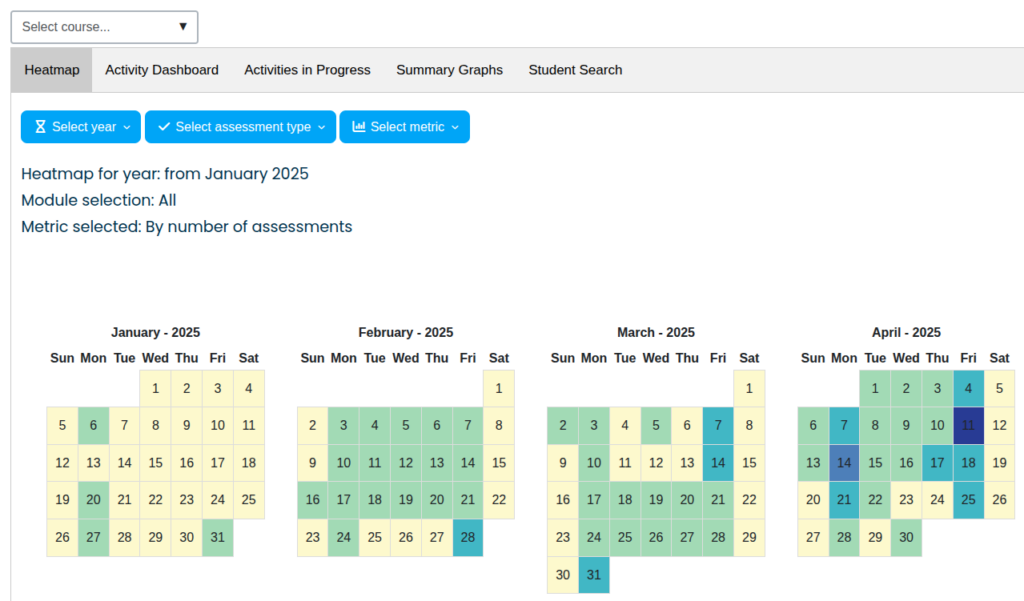
The dashboard also incorporates activity analytics, allowing staff to see which students are engaging with assignments and quizzes, and which may require additional support. Staff can also manage deadline extensions more efficiently, reducing administrative burden and ensuring that students receive timely adjustments.
The latest update introduces tag and category filtering. Institutions can now group and analyse assessments by programme, year of study, school or faculty. Moodle supports multiple tags per course, which means programme coordinators can build an accurate, fully up-to-date programme assessment calendar in an instant, removing the need for manual recreation each academic year.
“Now, instead of programme coordinators trying to manually create a programme assessment calendar at the start of every academic year, it can be done at the push of a button, and it is always up to date.”
— Dr Mark Glynn
By bringing together assessment distribution, student engagement insights and programme-level filtering, the dashboard supports more thoughtful planning, strengthens academic integrity, and improves the overall assessment environment.
Programme-Level Assessment Without Platform Lock-In
A common misconception is that programme-wide assessment insight requires a move to proprietary SaaS platforms. In reality, open source ecosystems such as Moodle already provide the foundation. They simply need to be used strategically.
With the right configuration, institutions can design a programme-level assessment approach that reflects their own pedagogical goals rather than a vendor’s roadmap. This shift is not only technical. It is cultural. It means moving from isolated module-level thinking to a connected, data-informed view of assessment across programmes.
This transformation relies on collaboration between academics, learning technologists and developers. Dashboards help visualise assessment distribution, analytics reveal trends that support curriculum design, and shared tools strengthen moderation and feedback. Together, these approaches enable universities to manage assessment strategically while retaining full ownership and flexibility. The Educators’ Pack from Catalyst was developed in that collaborative spirit. It demonstrates how open source innovation can deliver the reliability and performance educators need while keeping control firmly in the institution’s hands. It enables programme-level assessment within self-hosted Moodle without vendor lock-in, without costly migration, and with continuous improvements through supported updates.
Lessons from Practice: Transforming Digital Assessment in Moodle
At this year’s MoodleMoot Global, we discussed how collaboration and open-source development are transforming assessment at scale.
Through projects such as the Question Bank Collaborative Project and the development of the Assessment Frequency Dashboard with UCL and Cambridge, we are seeing what is possible when universities and partners work together to enhance Moodle for everyone.
One of the key messages from that session still stands:
We do not need to look elsewhere for solutions. Moodle can do it. The power lies in collaboration, in finding shared challenges and solving them together.
This ethos also underpins the Educators’ Pack, which translates community insight and partnership into practical tools that help institutions manage assessment more strategically and sustainably.
Taking Moodle Assessment Further
Every institution is at a different stage in its assessment journey. Some are beginning to build dashboards, others are redesigning feedback workflows, and many are exploring programme-level assessment to improve visibility and balance.
If your team is reviewing how assessment is managed across courses or programmes, the Catalyst Educators’ Pack brings together the tools, analytics and expertise to support that transition with confidence.
If you would like to discuss your institution’s assessment goals or see a demonstration of what is included, our team would be happy to talk through the options. Book a demo
Built for Today, Ready for Tomorrow