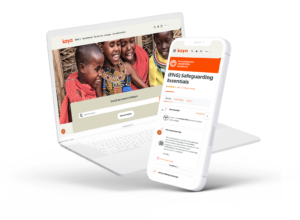
Through a strong partnership with Catalyst IT, the HLA successfully migrated Kaya, their Totara-based elearning platform, to Moodle Workplace, increasing the resilience and sustainability of their service and enabling other Moodle Workplace users to benefit from enhanced functionality
- Since 2016, Kaya has grown to one million registered learners across 195 countries, with 50 content delivery partners
- Originally built by Catalyst IT on Totara, Kaya was highly customised to support the unique business requirements of HLA and its numerous NGO education partners
- Catalyst IT supported Kaya’s migration to Moodle Workplace 4.5, going live in November 2025.
Background
Since the UK government approved the funding for the Humanitarian Leadership Academy in 2012, HLA has been steadily expanding its presence in vulnerable regions of the globe, pursuing its mission to support locally led responses to humanitarian crises.
In 2016, HLA launched Kaya, its elearning platform, offering a free catalogue of humanitarian skills training and knowledge, and enabling partnering aid agencies and charities to reach local areas with vital expertise on the ground.
To achieve this, HLA partnered with Catalyst IT to create from scratch a heavily customised version of Totara. During 2020- 2021, the platform’s user base grew by 100% as course providers needed to pivot to online learning during COVID. Since going live on Moodle Workplace in November 2025, Kaya has continued to grow, reaching one million registered learners in September 2026.
For more on KAYA’s beginnings, read the original Totara case study.
While HLA’s e-learning team has changed several times since Kaya first launched, its current team comprises: Shaun Richards, senior Technical Lead; Platform Learning and Development Leads Stephanie Luckhurst and Lynsey Jones; Fridah Okomo, Learning Platforms Support Officer; and Helena Dyer, Digital Platforms & Engagement Advisor.
Describing the complexity of HLA’s e-learning use case, Shaun says:
“We have a very unusual way of doing stuff!
“We not only serve learners directly with our material, we also sell platform space to partner organisations who create their own courses, manage their own users and deliver learning under their own branding. And we enable our partners to offer each other’s courses too without losing visibility of their branding.
“You could say this is a unique multi-tenancy requirement!” comments Shaun.
The Challenge: A Decade of Technical Debt
Over ten years, the necessary customisation to meet the demands of the Kaya application had accumulated significant technical debt. Bespoke plug-ins, custom fields whose original purpose had become unclear, and a portal-based architecture approximating multi-tenancy, but without integration, had rendered the platform unsustainable.
“The system had become a bit of a Frankensteinian platform, compounded by changing personnel,” says Stephanie.
“Every major Totara version upgrade became a project lasting several months, as all customisations needed to be verified or redeveloped if they didn’t work with the new version.”
Even when Totara introduced its own multi-tenancy features, the HLA platform had diverged so far from the core product that HLA could not easily benefit without significant rework.
“The platform had been shaped more by evolving need than deliberate design, and it became unwieldy and expensive to maintain,” Stephanie says.
The Requirement: Sustainability, Scalability and Familiarity
In a nutshell, the Kaya team needed to strike a better balance between high customisation and sustainability, improve platform scalability, performance and accessibility, reduce their system support costs and eliminate their technical debt.
“From our partners’ perspective, we also wanted it to be like introducing a familiar friend with a new hairdo!” Shaun adds.
Solution: Moodle Workplace
Nevertheless, the decision to choose Moodle Workplace was not taken lightly.
“We reviewed other platforms against considerations of licensing, functionality, scale, development roadmaps and user experience,” Shaun explains.
“Out-of-the-box multi-tenancy is a key capability, and mobile offline learning is a massive thing for us too, so we had to weigh up app availability and where the app was heading in the future.”
“We didn’t want to disrupt our partners too much either through providing something totally unrecognisable. It needed to be flexible to enable our partners to engage at the right product level for them, whether offering a handful of courses or a whole catalogue of both public and in-house training,” says Stephanie.
Describing the final choice, Shaun says:
“In the end it was the open source nature of Moodle Workplace that aligned best with our longer-term strategy. On Totara, customisation created ongoing maintenance overhead. On Moodle Workplace, any bespoke development HLA commissions can be submitted back to Moodle core.”
In 2023, HLA undertook a full procurement process and chose to move to Moodle Workplace independently of Catalyst. However, Catalyst’s familiarity with the Kaya project, and their long-standing relationship with Moodle, provided important continuity and the ability to submit developments properly to Moodle core.
Lynsey says: “Our history with Catalyst provided consistency and understanding, and because they are experts in both Totara and Moodle, we could trust them to advise on how things would translate across the two platforms.”
Approach: Establishing the proper migration path
With no established migration path from Totara to Moodle, Catalyst began with a structured audit of everything running on the Kaya platform. Every core feature, customisation and minor change was assessed against need, priority, replicability in Moodle Workplace and required development effort.
Technical Migration
Although Totara was originally built on a Moodle base, the two forked in 2019, so a direct database migration between the two is no longer straightforward.
Instead, Catalyst stepped back HLA’s Totara instance to the point at which it had diverged from Moodle and then upgraded it forward along the Moodle path to Moodle 4.5, before applying the Moodle Workplace 4.5 layer on top.
An early proof-of-concept dry run showed that the core content data, user profiles, and user completion records transferred largely intact. This confirmed the migration approach was correct, and was faster than rebuilding from an empty Moodle Workplace instance.
Catalyst then created migration scripts to convert Totara database structures into their Moodle Workplace equivalents.
Functionality gaps
Alongside the audit Catalyst ran workshops on Moodle Workplace core features, to determine how the proposed solutions met HLA’s operational scenarios, identify alternatives and help HLA assess how to adapt their workflows.
Explaining how gaps have been addressed Shaun says: “Catalyst have been able to resolve differences in core features through careful permission configurations rather than code changes.
“For example, audience-based and cross-tenant course visibility are key features of our partner offering, for which we needed to develop workarounds in Moodle Workplace.”
In the case of course-level branding, Catalyst have implemented a code-level customisation to enable all courses to retain their original branding regardless of which tenant the user belongs to.
“Catalyst is working to promote this and other customisations into Moodle Workplace core so we don’t have to maintain the bespoke code at the next major upgrade, and so the core is enhanced,” explains Shaun.
“This is worth the admin effort of configuring permissions for other core features!”
Balancing Business as Usual
With no dedicated project budget, HLA and Catalyst had to balance Business As Usual SLA hours with defining and managing the transition.
Lynsey says: “As a partnership, we had to focus on the most cost-effective approach. We divided labour between manual tasks and migration scripts. Anything that was below 100 instances would be performed manually in-house and anything above would be scripted.”
As well as continuing to provide day-to-day support of the live Totara platform, Stephanie and Lynsey managed partner communications throughout, pacing information releases to coincide with confirmed, stable elements of the new platform, and running webinars as the launch approached.
Go-live
Go-live was completed without significant issues after the site was taken down for two weeks in November 2025. This provided Catalyst with one week to run all scripts and complete its own testing, and HLA with one week to carry out manual configuration and user acceptance testing.
Results and Benefits
Reduced monthly support bill
“One of our key aims with the migration was to be able to substantially reduce our monthly support costs,” says Shaun.
“We used to pay Catalyst for 120 hours of support each month, which was frequently insufficient to complete all the work. With Moodle Workplace this has reduced to 40 hours, and now we don’t use all of them!
“Even so, Catalyst are still with us and are using our hours to upstream our customisations to the Moodle Workplace core, enabling us to give back functionality to the community.
“This is an important reason why we trust them!”
Increased autonomy
“We can now bring a new partner onboard, including setting up fully branded dashboards, logos, colours and layout without any involvement from Catalyst, whereas previously they would have had to be involved,” Stephanie says.
Timely fixes and Improvements
“When HLA identifies a bug or wants a new capability, Catalyst can deploy a fix to the production site within a week. Catalyst then works to contribute that fix upstream to Moodle core, meaning HLA’s improvements become available to the wider Moodle Workplace community,” Shaun says.
“So Moodle gets working bug fixes without having to build the fix themselves, we receive timely improvements, and the open source eco-system benefits too. It’s a win-win-win!”
Celebrating decade-long tenants
“2026 is the year to celebrate our partners who have been with us from the beginning and for whom the migration means many more stable years of elearning capability,” says Stephanie.
“We are keen to tell their stories and feature the different ways Kaya has benefited their operation.”
New Possibilities
Future development areas include AI adoption, community features and linking opportunities that were not viable on the legacy platform.
HLA and Catalyst are also in early discussions with other NGOs using Moodle Workplace in non-standard configurations, with the aim of co-funding feature development.
Recommendation
Reflecting on HLA’s relationship with Catalyst, Stephanie says:
“We’ve dealt with pretty much the same staff members at the Catalyst end since 2016. They understand our use case and have been alongside us throughout the entire Kaya journey. Their dedication, thoroughness and ethos of continuous improvement is unrivalled.”
Catalyst IT says
“This project has provided us with a vast amount of learning about how to carry out Totara-to-Moodle Workplace migrations, and what pitfalls to avoid. We have shifted into a new era of platform improvement rather than customisation maintenance. Given their mission to deliver free, accessible learning to humanitarians responding to crises around the world, it follows that HLA is oriented towards collective rather than proprietary development, and it is a privilege to support them.”
More Partnerships stories
Discover how other organisations are working with Catalyst to improve their learning platforms and support their learners.
With Catalyst, you have the Freedom to Innovate.