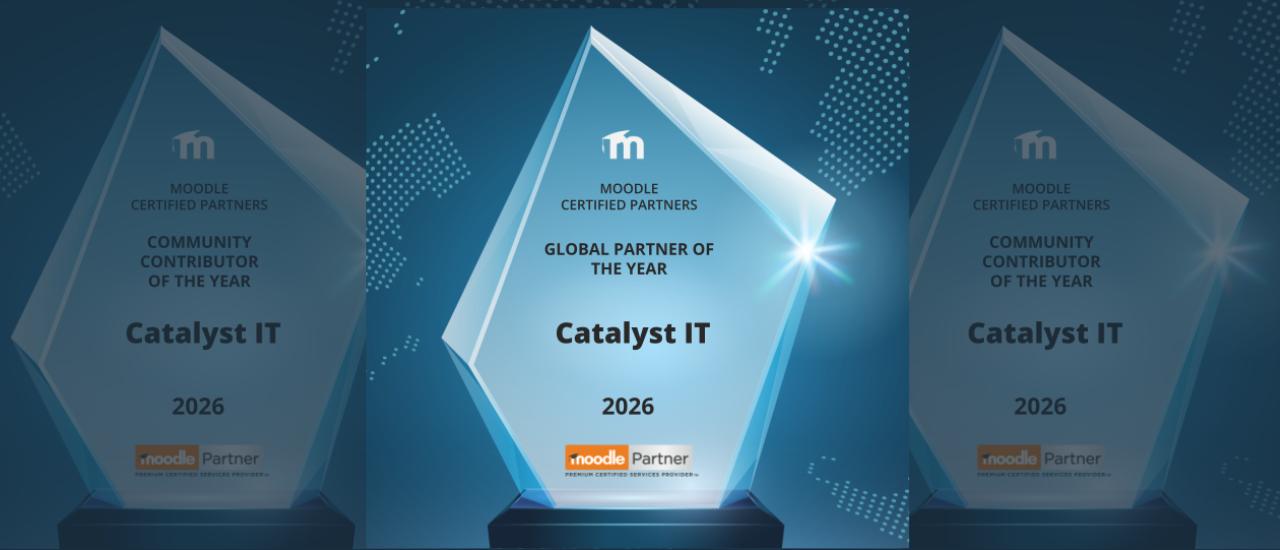
I’m delighted to share that Moodle HQ has named Catalyst IT Moodle Global Partner of the Year 2026. It’s the third time we’ve received this award since 2019. At the same Moodle Partner Awards in Barcelona, we were also named Community Contributor of the Year, for the second year in a row.
These awards belong to the whole Catalyst IT group, our colleagues across Europe, Australia, Canada and New Zealand. But I want to use this post to talk about what sits underneath them, because it’s something I care about deeply: what it really means to be a Moodle partner.
A Moodle partner, not just a Moodle provider
Because Moodle is open source, anyone can host it. Being a Moodle Certified Partner is something quite different.
To become a Moodle Certified Partner, you have to pass a technical evaluation, keep up regular quality and compliance reviews, and actively collaborate with Moodle HQ. Part of every partner’s revenue also goes back into Moodle’s development. The Catalyst group has been a Premium Moodle Certified Partner for more than 20 years.
A provider looks after your platform. A partner does that too, but also works alongside you, the wider community and Moodle HQ. We listen to what institutions need, share what we’re all learning and help turn common challenges into improvements that everyone can use.
It’s something Moodle HQ recognises too. As Dan Lehner, Moodle’s Chief Commercial Officer, puts it:
“We would always recommend that higher education institutions partner with a certified Moodle partner. One reason is just the closeness of the relationship. By working with someone like Catalyst, they’ve always got a seat at the table. Catalyst has been the closest of partners with Moodle since day one, contributing not just to the core code, but to all sorts of integrations, applications and plugins built around that, often on behalf of their customers.”
Dan Lehner, CCO, Moodle
In addition to our own experience, partnering with Catalyst means you can also benefit from the wealth of experience within our community. That partnership is built in the community, and this year that included our Moodle Community Day at Queen Mary University of London: a day for the community, not a sales pitch, where institutions shared what’s working and what isn’t. We also visited universities across London alongside Moodle HQ, so they could hear directly from the people who use Moodle every day.
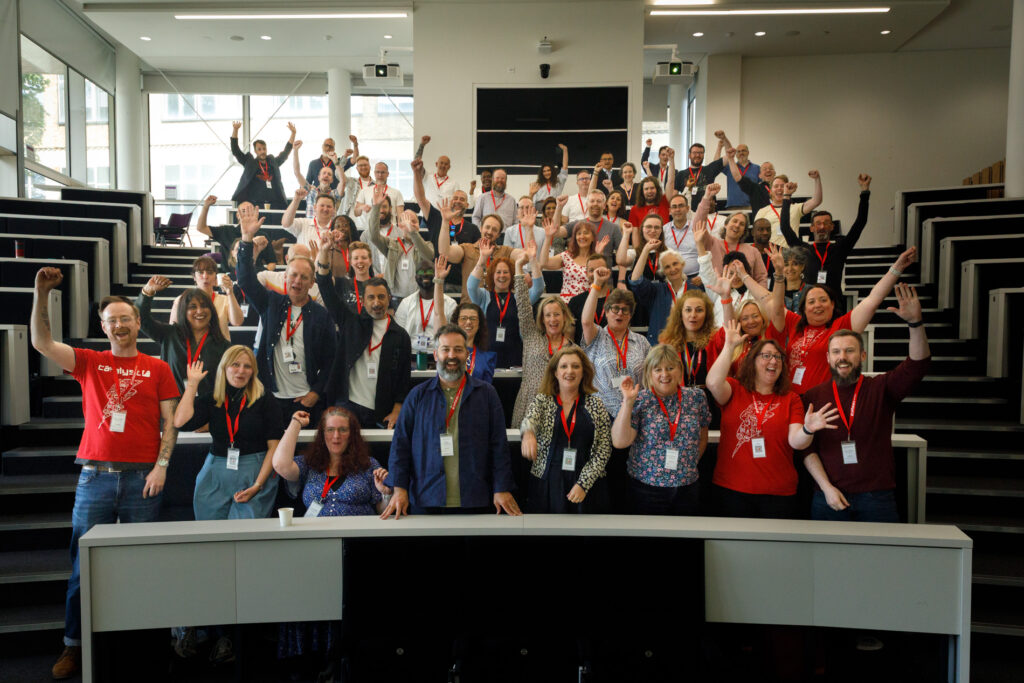
“It was a real pleasure to attend Catalyst’s recent community event and spend time hearing directly from the people who use Moodle every day. Those conversations are incredibly valuable: they help us better understand the challenges institutions are facing, the successes they’re achieving and where we can continue to improve together.”
Scott Anderberg, CEO, Moodle
And it isn’t just the UK. Across the group, our colleagues host MoodleMoot Australia and MoodleMoot Canada, bringing institutions, partners and Moodle HQ together in the same way wherever we work.
Our partner status really matters to the universities we work with. When the University of Warwick chose Catalyst this summer, it said our partner status means Warwick’s voice will be heard in shaping the future of the platform. That’s what partnership should mean.
Partnership in action: Multiple Marking
Our Community Contributor award recognises the Multiple Marking Project, and it’s the clearest example I can give of what that partnership looks like in practice.
It started with UCL, who recognised that many universities have more than one person mark the same piece of work to keep assessment fair and consistent, but much of the coordination between markers happened outside Moodle. Alistair Spark and the team at UCL had a clear idea of how Moodle could do better. UCL has always made sure that what it builds can go back into Moodle core, and it’s willing to fund the extra work that takes.
We championed the idea alongside UCL, sharing it with the community and building interest from other institutions. The University of Bath, King’s College London and Monash University joined as funders. Then we brought in Moodle HQ.
That journey took us to Sydney in November 2025, where Catalyst helped bring together the first Marking Workflow Workshop. Senior representatives from UCL, King’s and Monash sat in the same room as Moodle HQ, our Catalyst IT Australia colleagues and our team in Europe to map out what came next.
The results are now in Moodle itself. Open double marking arrived in Moodle 5.2, with separate initial markers and agreed feedback following in Moodle 5.3. You can read the full story in our Multiple Marking progress update.
It began as one university’s idea. Now every institution using Moodle can benefit from it.
Let’s build the next one together
For Moodle, there’s a lot more to open source than sharing code. It’s about sharing ideas, experience and effort, so that everyone benefits from what one institution learns. That’s why these awards mean so much to us.
If your institution has an idea that could make Moodle better for everyone, we’d love to work on it with you. You can find out how to join Multiple Marking in UCL’s guide to joining the project, or get in touch with our team.
Thank you to Moodle HQ for the recognition, and to every institution that trusts us, challenges us and contributes so much. Congratulations, too, to all of this year’s Moodle Partner Award winners.
With Catalyst, you have the Freedom to Innovate.