
Giving students meaningful feedback is one of the most time-consuming parts of teaching. It can be inconsistent from teacher to teacher and even inconsistent within the same teacher after a long weekend of marking. When I was teaching, the quality of my marking dropped noticeably by the end of a Sunday evening spent staring at a screen.
There is also the issue of timing. By the time students receive feedback, they have often forgotten the details of the task. Large Language Models, or LLMs, can help by offering a first round of feedback instantly while the question is still fresh in the student’s mind.
The AI Feedback Question Type brings this capability directly into Moodle’s assessment workflow. It is designed with educators, for educators, to help them provide richer, faster, and more consistent formative feedback.
Where the Idea Came From
I spent ten years as a teacher and a very large portion of that time was spent marking. Much of it could have been better spent supporting students directly. When LLMs like ChatGPT arrived, it struck me that they could generate a first cut of feedback almost instantly.
I began working on the concept for what became AI Text in November 2023 and announced the idea publicly on Christmas Day that year. Although the prototype was built with ChatGPT, the plugin is designed to work with as many LLM systems as possible so educators are not tied to a single provider. It can even run with a local LLM that requires no internet connection at all.
What the Plugin Does
Each question created using the AI Feedback Question Type includes three core elements:
Question stem:
The prompt shown to the student, for example, “Write an English sentence in the past tense”.
Response prompt:
Used to evaluate the student’s answer. Writing good prompts requires an understanding of how LLMs behave. Some model versions tend to give overly positive responses, so a prompt may need to specify that only valid English or sensible answers should be considered.
Optional marking prompt:
Additional instructions or criteria to guide feedback.
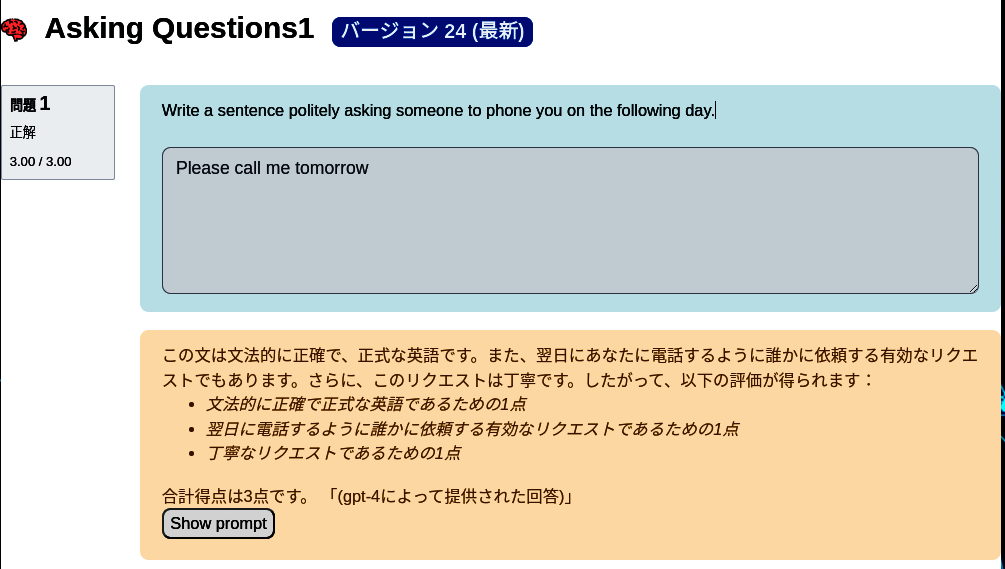
This question type has been used widely in language teaching because it can provide feedback in the student’s first language, making it easier for learners to understand and act on the advice they receive.
The Wow Moment
The power of multilingual feedback became clear when I demonstrated the plugin at MoodleMoot Japan in February 2024. Teachers could see feedback being generated instantly in the student’s native language, which made it much easier for learners to understand where they had gone wrong. That moment resonated strongly, and the plugin has since been widely adopted in language teaching teams.
Why was it created
I have been building web-based quiz systems since 1999 and the field has long been dominated by multiple choice questions, which students often call “multi guess”. A student can get the right answer by chance without understanding the question.
In 2012 I released the Gapfill question type, which gave teachers more flexibility, but it still required teachers to define every acceptable answer and could not handle fully free text. Attempts to accommodate free-text responses existed, but they were difficult to use and limited in scope. When LLMs arrived, it was clear that they opened up an entirely new level of capability.
They finally gave teachers a practical way to handle free-text answers at scale.
Headline Benefits
Easy for teachers to learn
Works within existing Moodle workflows with minimal setup.
Saves teachers time
Reduces the hours spent on repetitive marking.
Instant feedback for students
Learners receive formative guidance immediately, when it matters most.
Consistent feedback
Reduces variation between markers and promotes fairness.
Supports quality at scale
Enables large cohorts to receive meaningful, personalised formative feedback.
Limitations and Considerations
This plugin is not intended for high-stakes assessment. LLM systems are non-deterministic, which means they may produce different responses for similar prompts. For that reason, the question type should be used for formative feedback rather than summative grading.
Using the plugin requires an external LLM, which carries a financial cost. In practice, the cost per student is usually counted in pennies and the cost of LLM access continues to fall.
Educators should also be aware of the wider regulatory landscape. The EU AI Act lists AI systems that evaluate learning outcomes as high risk. However, a high-risk classification does not mean the technology should not be used. It simply means it should be applied with care, transparency, and appropriate controls. You can read the relevant section here: EU AI Act, Annex 3 Section 3b
Download and Install
You can download the plugin here:
https://moodle.org/plugins/qtype_aitext
Compatibility: Moodle 4.5 to 5.1
Getting started:
- Enable the plugin in Moodle.
- Obtain an API key for your chosen LLM provider and add it to the plugin configuration.
- Create and test your first question.
- Trial it with a small group of students to gather initial feedback.
Early Feedback
Professor Robert Hirschel from Sojo University in Japan shared:
But (and I almost never use ALL CAPS), this is EXTREMELY EXCITING. Providing grammatical feedback to students is exceptionally time-consuming for teachers, and is quite frequently incomprehensible to students.
What’s Next
The development roadmap is available here:
https://github.com/marcusgreen/moodle-qtype_aitext/wiki/Roadmap
It is an active document that evolves in response to educator needs and suggestions.
Conclusion
Open source gives educators the freedom to choose tools they can understand, improve, and control. With AI Text, you have full access to the source code under the GPL. It has been tested with a wide range of AI systems, including models that run entirely on your own machine so that student responses never leave your organisation.
Most teachers did not enter education because they enjoy marking. This plugin helps automate the repetitive parts so that educators can focus on the expert judgement, relationship building, and teaching that have the greatest impact on learning.
AI Text is already installed on more than 270 sites worldwide. It is a practical example of how Moodle and open source innovation continue to evolve with the needs of modern education.
With Catalyst, you have the freedom to innovate.